Five years after the pandemic broke the five-day office week, Indian companies have largely settled on hybrid. The shape varies; some teams are in three days a week, some are two, some are flexible by manager. The direction does not.
What has not settled, in many companies, is the equipment side of that decision. The office has fewer permanent desks. The home setup is whatever the employee built for themselves at the start of 2020. The gap between the two has been quietly widening.
This post is a general overview of the hybrid device gap in India in 2026: what it is, why it persists, and what the better-organised companies are doing about it.
What "hybrid" actually looks like in India in 2026
The Nasscom Return to Workplace Survey series has tracked this shift over the last few years, and the picture is consistent. A majority of Indian knowledge workers prefer a hybrid mix over either extreme. Junior and senior employees lean towards more office time; the middle of the curve leans flexible.[¹]
Even employers who would prefer everyone back full-time have largely given up on it. Nasscom's recent commentary on the 2026 workplace points to flexibility, quality, and sustainability as the three forces shaping office design through the rest of the decade.[²] The five-day office is not coming back as the default.
What follows from that is that companies have to be good at two physical environments, not one. The office still matters, but the home matters too.
The gap, in plain terms
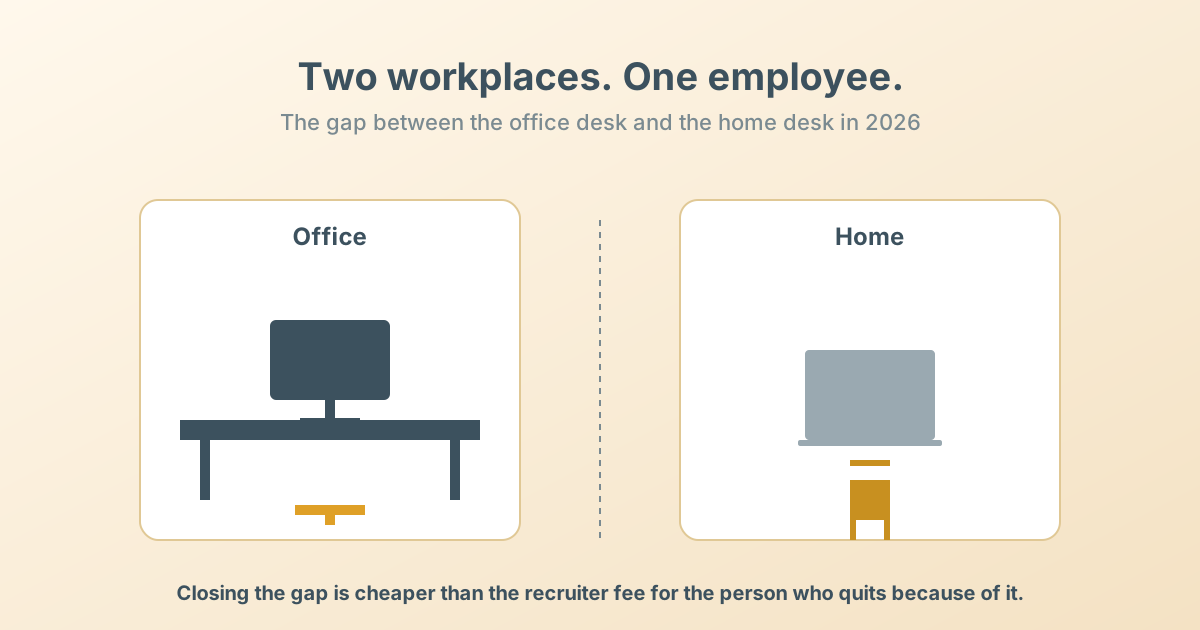
Walk into a well-run Indian office in 2026 and the desks are clean. Monitors are the right height. Chairs do not creak. The Wi-Fi works.
Walk into the same employee's home setup and the picture is often very different. A four-year-old laptop. A kitchen chair. The router from the broadband provider sitting on top of the TV. The headset that came free with a phone purchase in 2022.
The employee is, on paper, hybrid. In practice they are doing their best work in the office and their tolerable work at home. Output is meaningfully different across the two environments, even though their calendar treats them as equivalent.
The EY India Work Reimagined surveys have noted this pattern: companies offering genuine flexibility see meaningful gains in attraction, retention, and productivity, but only when the flexibility is supported by the underlying setup.[³]
Why the gap has persisted
Three reasons keep coming up.
The first is that hybrid happened faster than corporate IT could adjust. In 2020 the priority was just to keep things running. In 2021 and 2022 the priority was to bring people back. By the time companies accepted that hybrid was the steady state, the policy lag was already a couple of years deep, and home setups had aged accordingly.
The second is that home device provisioning is operationally hard if you do it the old way. Buying every employee a desk, chair, and second monitor at home does not scale to thousands of people. Reimbursing them does not scale either; the receipts pile, the categories blur, the policy creeps.
The third is that the budget conversation is awkward. Office furniture is a capex line every CFO understands. Home furniture is somehow different, even though it is being used by the same employee for the same work.
Each of these is solvable. None has solved itself.
What the better-organised companies are doing
Three patterns have emerged across the companies that take the hybrid setup seriously.
The first is to treat the home as part of the workplace rather than an exception. That means setting a basic standard - a workable laptop, a chair that is not a folding plastic one, a reliable network - and making that standard reachable for every employee, not just the senior ones.
The second is to move the procurement off the company's own balance sheet where possible. Leasing programmes that include furniture and devices let the employee pick something they actually want, give the company a predictable monthly line, and avoid the messy reimbursement loop. EY's broader work on holistic rewards keeps coming back to this pattern: the companies winning the talent war are the ones that make day-to-day life easier in operationally light ways.[⁴]
The third is to admit that the gap is not just about hardware. Faster home Wi-Fi matters. Decent lighting matters. The employee not feeling like they are working from a half-finished kitchen matters. Companies that have started thinking about hybrid at the level of "what does this employee see when they sit down on a Tuesday morning" are pulling ahead.
How device leasing fits the picture
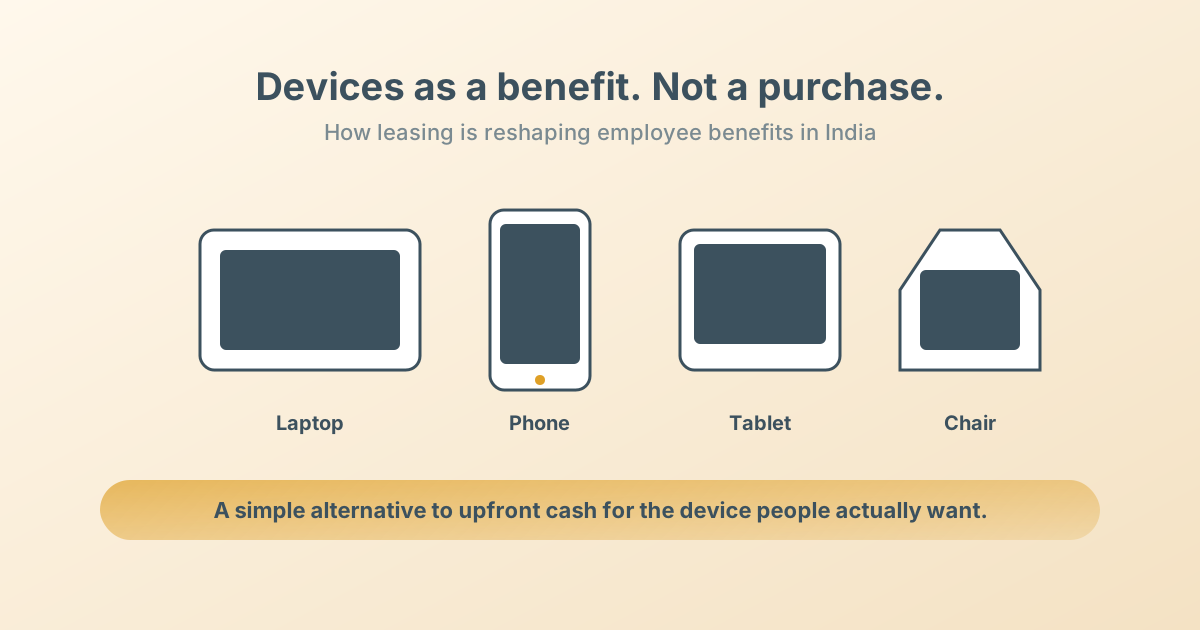
A structured device-leasing programme is one of the cleaner ways to close the gap.
It gives employees access to current-generation devices without a four-figure upfront purchase. It moves the cost into a predictable monthly line on the employer's books. It usually bundles in support and replacement, which means a broken laptop in Bengaluru does not become an HR ticket in Gurugram.
And critically, it lets the company offer the same standard to a 26-year-old engineer and a 36-year-old engineering manager, without separate procurement loops for each level.
For the employee, the experience is closer to a benefit than a transaction. The device shows up; the payroll line is gentler than a self-purchase would have been; the upgrade cycle is predictable. The employer carries the operational weight; the employee gets the upgraded experience.
We have written about the general shape of this in How device leasing is changing employee benefits in India. It applies straightforwardly to the hybrid-setup problem.
A short checklist for HR teams
If you are looking at the hybrid setup in your company and wondering whether there is a gap to close, the quickest test is to ask a recent joiner what their first two weeks looked like.
If the answer involves them buying their own home laptop because the company-issued one was late, you have a gap.
If the answer involves them sitting on a kitchen chair for the first month, you have a gap.
If the answer involves them paying for a second monitor that they did not get reimbursed for cleanly, you have a gap.
None of these gaps are catastrophic. All of them quietly chip away at the employee's sense that this is a serious place to work. Closing them is cheaper, in real money, than the recruiter fees of replacing the person who quit because they got tired of the kitchen chair.
Where to read next
- How device leasing is changing employee benefits in India
- Why HR leaders are moving away from reimbursement
- When a small benefit beats a bigger salary hike
If your team is thinking about how to operationalise hybrid equipment without an IT-purchasing nightmare, hello@innovrent.com is a sensible first email.
Sources
- Nasscom, Return to Workplace Survey - Evolving Towards Hybrid Operating Model. https://nasscom.in/knowledge-center/publications/nasscom-return-workplace-survey-evolving-towards-hybrid-operating
- Nasscom community, Flexibility, quality, and sustainability to shape India's workplace revolution in 2026. https://community.nasscom.in/communities/global-capability-centers/flexibility-quality-and-sustainability-shape-indias-workplace
- EY India, The future of pay: Holistic rewards redefining talent strategies. https://www.ey.com/en_in/insights/workforce/the-future-of-pay-holistic-rewards-redefining-talent-strategies
- EY India, Future of Pay 2026 report (press summary). https://www.ey.com/en_in/newsroom/2026/02/india-inc-projects-9-point-1-percent-salary-increase-in-2026-as-compensation-becomes-sharper-more-skills-led-ey-future-of-pay-2026-report